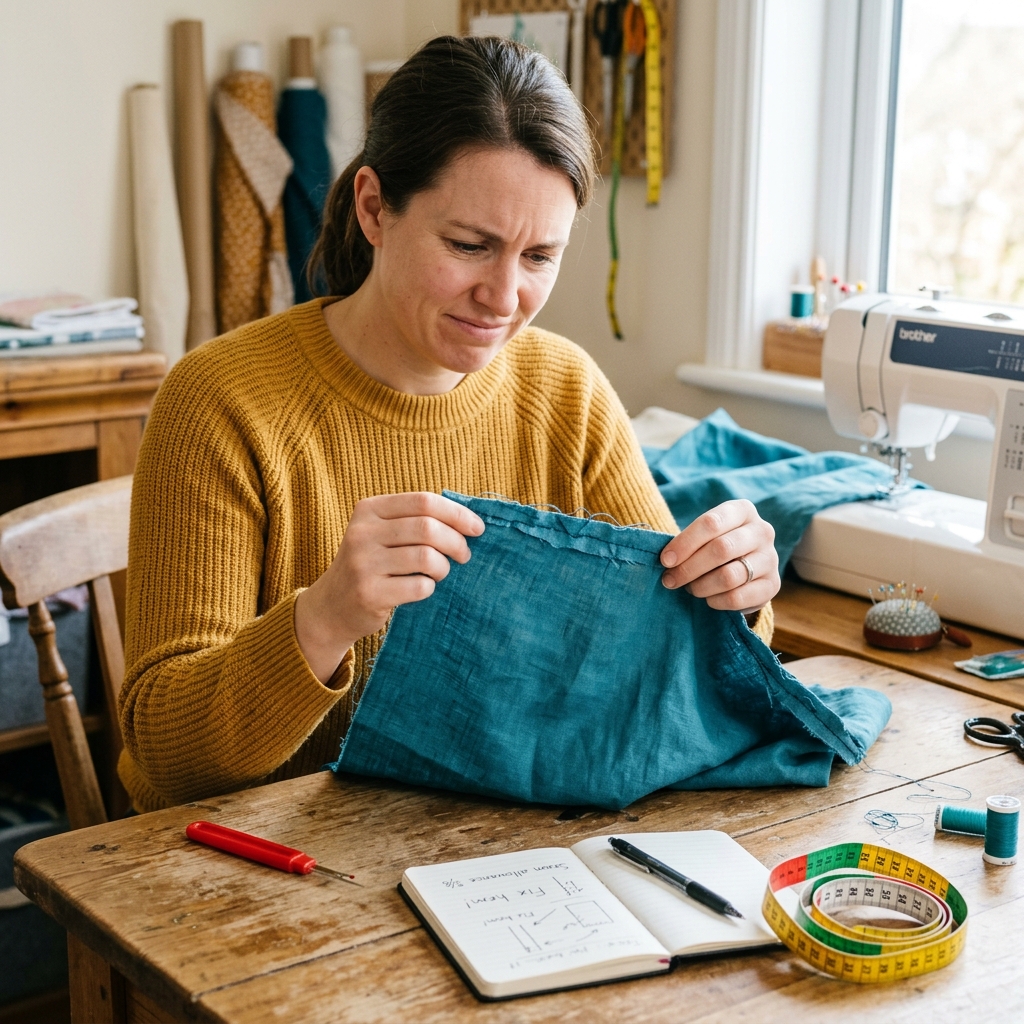
A circle skirt is often touted as the “perfect beginner project,” but that doesn’t mean it’s without its pitfalls. Because the garment relies so heavily on geometry and bias-cut fabric, a small error in the beginning can lead to a very visible problem at the end.
If you’ve ever ended up with an uneven hem, a waistband that won’t close, or a skirt that looks like a lampshade, you’ve likely fallen into one of the common mistakes when making circle skirts.
Don’t reach for the seam ripper just yet! In this guide, we’ll identify the most frequent sewing errors and, more importantly, show you exactly how to fix or avoid them in your next project.
Mistake 1: The “Wonky” Uneven Hem
This is the #1 complaint in circle skirt sewing. You cut the skirt perfectly, but after wearing it once, the sides are 2 inches longer than the front and back.
The Cause:
Circle skirts are cut on the bias (the 45-degree angle of the fabric grain). Fabric is much stretchier on the bias than on the straight grain. Gravity causes these sections to “drop” or stretch out over time.
The Fix:
The 24-Hour Hang. After you’ve sewn the skirt together but before you hem it, hang it on a hanger for at least 24 hours (48 is better for heavy fabrics). Let gravity do its work. Then, use a hem marker or a friend to re-level the hem while you are wearing the skirt. Trim the excess, and then hem.
Mistake 2: Forgetting the “Hip Rule” for Elastic Waists
You’ve made a beautiful skirt with a comfy elastic waistband, but you can’t get it over your hips.
The Cause:
You calculated the waist hole radius using your natural waist measurement. Since the waistband is a closed loop, it must be large enough to pass over the widest part of your body (your hips).
The Fix:
When drafting an elastic waist circle skirt, always use your hip measurement as the “circumference” in the formula. Use our Circle Skirt with Elastic Waist DIY Guide for the specific math. If you’ve already cut it too small, you may need to cut a slit and install a zipper instead.
Mistake 3: The “Lampshade” Effect (Wrong Fabric Choice)
Your skirt stands out stiffly like a tent instead of flowing gracefully around your legs.
The Cause:
You used a fabric that is too stiff or heavy for the amount of volume in the skirt. A full circle skirt in heavy denim or upholstery fabric will have so much structure that it won’t “collapse” into soft folds.
The Fix:
Match the fabric drape to the skirt volume. Full circle skirts need lightweight or drapey fabrics (rayon, silk, thin cotton). If you want to use a heavy fabric, stick to a quarter-circle or half-circle style. Check our guide on the Best Fabrics for Circle Skirts to avoid this.
Mistake 4: Skipping the Pre-Wash
Your skirt fits perfectly on the first day, but after one trip through the laundry, it’s too tight and 3 inches shorter.
The Cause:
Fabric shrinks. Woven fabrics like cotton and linen are especially prone to this.
The Fix:
Wash and dry your fabric exactly as you plan to treat the finished garment before you even pick up the scissors. This “pre-shrinks” the material so your measurements stay accurate.
Mistake 5: The Puckered Waistband
The seam where the skirt meets the waistband is full of tiny, unwanted gathers or puckers.
The Cause:
The waist hole (which is a curve) has stretched out of shape while you were handling it. Because it’s cut on the bias, it grows very easily. When you try to sew it to a straight, stable waistband, the skirt is now “larger” than the band, forcing you to gather the excess.
The Fix:
Stay-stitching. As soon as you cut your waist hole, sew a line of regular stitches 1/4 inch from the edge all the way around. This “locks” the fibers in place and prevents them from stretching.
Mistake 6: “Math Fatigue” Leading to Cutting Errors
You calculated your radius as 4.7 inches but accidentally cut at 5.7 inches.
The Cause:
Manual calculation errors or misreading a measuring tape. In a circle, a 1-inch error in radius results in a 6.28-inch error in waist circumference!
The Fix:
Double-check your math before cutting. Or better yet, use our circle skirt calculator tool to get guaranteed accurate numbers. Always “measure twice, cut once.”
Summary: Quick Troubleshooting Guide
| Problem | Likely Cause | Solution |
|---|---|---|
| Uneven Hem | Bias stretch | Hang for 24h before hemming |
| Won’t fit over hips | Used waist measurement for elastic | Use hip measurement instead |
| Stiff/Bulky look | Fabric too heavy for style | Use drapey fabric for full circles |
| Puckered waist | Stretched bias edge | Stay-stitch immediately after cutting |
| Waist too large | Calculation error | Redo math with the calculator tool |
❓ FAQ SECTION
Why is my circle skirt hem uneven? This is caused by “bias stretch.” Parts of the skirt are cut on the diagonal grain of the fabric, which stretches under its own weight. To fix it, hang the skirt for 24-48 hours before hemming to let it settle.
What are the most common circle skirt mistakes? The most common mistakes are not stay-stitching the waist (causing stretch), choosing a fabric that is too stiff for the style, and forgetting to account for hip width when making an elastic waistband.
How do I fix a circle skirt waist that is too big? If the waist is only slightly too big, you can add small darts or slightly gather the fabric into the waistband. If it’s significantly too big, you may need to convert it into a wrap skirt or add a wider elastic band.
How do you calculate a circle skirt without mistakes? The best way to avoid errors is to use a dedicated circle skirt calculator. It removes the risk of manual math errors and provides exact measurements for radius and yardage.
🎯 Ready to Try Again?
Mistakes are just part of the learning process! Now that you know what to look out for, your next circle skirt will be your best one yet.
Open the Circle Skirt Calculator to get your perfect measurements, and check out our Circle Skirt Pattern Drafting Guide for a step-by-step walkthrough that helps you avoid these common pitfalls.
If you’re still choosing your silhouette, see our Full vs Half vs Quarter Circle Skirt comparison to pick the style that best matches your fabric and skill level.