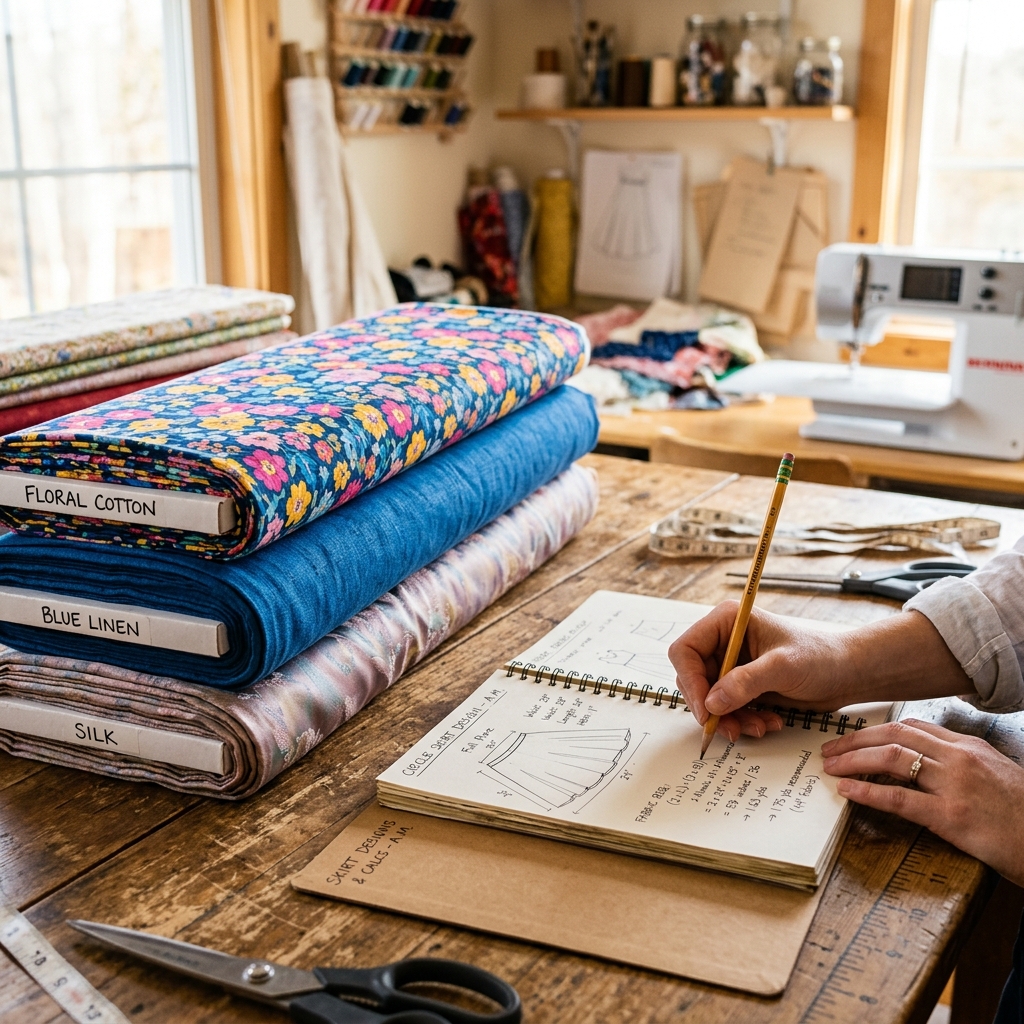
There is no worse feeling in the sewing room than being 75% of the way through cutting a pattern only to realize you’re two inches short of fabric. Because circle skirts are essentially giant geometric shapes, they are notorious for being “fabric hogs.”
If you’ve ever asked, “How much fabric is needed for a circle skirt?” and received a vague answer like “it depends,” you aren’t alone. In this guide, we’re going to break down the exact math of yardage, discuss how fabric width changes everything, and provide easy-to-use tables so you can shop with confidence.
The Factors That Determine Yardage
Before we get to the numbers, you need to understand the three variables that dictate how much fabric you’ll need to buy.
1. Skirt Type (Full, Half, or Quarter)
As we discussed in our Full vs Half vs Quarter Circle Skirt comparison, the “angle” of your skirt dramatically changes the fabric footprint.
- Full Circle: Requires a square of fabric twice as long as your (Radius + Length).
- Half Circle: Can often be cut more efficiently but requires a long stretch of fabric.
- Quarter Circle: The most fabric-efficient.
2. Skirt Length
Every inch you add to your length measurement adds two inches to the diameter of your fabric square. A floor-length maxi skirt uses significantly more than double the fabric of a knee-length skirt.
3. Fabric Width (44” vs 60”)
Standard apparel fabric usually comes in two widths:
- 44/45 inches (115cm): Common for quilting cotton, silks, and narrower linens.
- 58/60 inches (150cm): Common for knits, wools, and modern apparel fabrics.
The “Width Limit”: If your (Radius + Length) is greater than half the width of your fabric, you cannot cut a full circle in one piece. You will have to cut it in multiple sections (half-circles) and sew them together, which increases the amount of yardage needed due to seam allowances and layout.
How to Calculate Yardage Manually
If you want to do the math yourself, here is the basic formula for a Full Circle Skirt being cut in one piece on folded fabric:
Total Length Required = (Radius + Skirt Length + Hem Allowance) × 2
Example:
- Radius: 5 inches
- Length: 20 inches
- Hem Allowance: 1 inch
- Total: $(5 + 20 + 1) \times 2 = 52$ inches.
- Since a yard is 36 inches, you would need $52 / 36 = 1.44$ yards. (Round up to 1.5 or 2 yards to be safe).
Circle Skirt Yardage Tables
These tables provide a “safe” estimate for a person with a 30-inch waist. If your waist is larger, add 0.25 to 0.5 yards to these estimates.
Table 1: Full Circle Skirt Yardage (60” Wide Fabric)
| Skirt Length | Yardage (Approx) | Notes |
|---|---|---|
| Mini (15”) | 1.5 Yards | Usually fits in one piece |
| Knee (22”) | 2.5 Yards | May need side seams |
| Midi (30”) | 3.5 Yards | Will definitely need side seams |
| Maxi (40”) | 4.5 - 5 Yards | High waste due to layout |
Table 2: Half-Circle Skirt Yardage (60” Wide Fabric)
| Skirt Length | Yardage (Approx) | Notes |
|---|---|---|
| Mini (15”) | 1.0 Yard | Very efficient |
| Knee (22”) | 1.75 Yards | |
| Midi (30”) | 2.5 Yards | |
| Maxi (40”) | 3.5 Yards |
The “Bias Cut” and Fabric Direction
One thing the math doesn’t tell you is how the direction of the fabric affects your yardage.
- Directional Prints: If your fabric has a print that only goes one way (like birds standing upright), you cannot flip the pattern pieces to save space. You will need roughly 20–30% more fabric to ensure all the birds are right-side up on both the front and back of the skirt.
- Napped Fabrics (Velvet/Corduroy): Similar to directional prints, velvet looks different when brushed up vs. down. You must cut all pieces in the same direction, which increases yardage.
- Plaids and Stripes: If you want your stripes to match at the seams, buy an extra 0.5 to 1 yard.
Efficient Layout Hacks
Want to save money and fabric? Try these tips:
- Use 60” Wide Fabric: Whenever possible, choose wider fabric. It allows you to cut longer skirts without adding seams, which drastically reduces the “dead space” between pieces.
- The “Two-Half” Method: Instead of trying to cut a full circle from one large piece, cut two half-circles. This allows you to nestle the pieces together on the fabric, often saving 0.5 to 1 yard.
- Shorten Your Hem: Using a bias binding or a very narrow rolled hem requires less “hem allowance” (0.25” vs 1.5”), which can sometimes save you from needing that extra half-yard.
Summary: Buying the Right Amount
| If you are making a… | And your fabric is… | Buy this much… |
|---|---|---|
| Short Full Circle | 60” Wide | 2 Yards |
| Long Full Circle | 60” Wide | 4 - 5 Yards |
| Half Circle | 44” Wide | 3 Yards |
| Quarter Circle | 44” Wide | 1.5 Yards |
❓ FAQ SECTION
How much fabric do I need for a circle skirt? A typical knee-length full circle skirt requires about 2.5 yards of 60-inch wide fabric. If your fabric is narrower (44 inches), you may need 3.5 yards or more.
What is the formula for circle skirt yardage? The simplest formula is $(Radius + Length + Hem) \times 2$. This gives you the length of the square needed. Divide this by 36 to get the yardage.
Can I make a circle skirt with only 1 yard of fabric? Only if it’s a very short mini-skirt or a child’s skirt. Most adult circle skirts require at least 1.5 to 2 yards to account for the waist hole and the flare.
Does waist size affect how much fabric I need? Yes. A larger waist results in a larger waist radius, which pushes the entire skirt outward, requiring more fabric.
🎯 Never Guess Again
Calculation errors are expensive. To get a precise measurement tailored to your exact waist size, skirt length, and fabric width, use our circle skirt calculator tool. It provides a visual guide and exact yardage requirements so you never buy too much or too little.
Once you have your fabric, make sure you know how to measure for a circle skirt correctly to ensure those yards turn into a masterpiece!